On the morning of the twenty-third
The Ueno Sweep
Police arrested 180 homeless people sleeping in and around Ueno’s underground passages and park, ostensibly to prevent further shootings by a wanted criminal. They photographed and fingerprinted the detainees, sent a few to hospitals or an old-age home, and released the rest after they promised not to return to the streets.
On the evening of the twenty-third
The Shinjuku Death
A forty-year-old vagrant was found dead in the busy underground passage at Shinjuku Station, where he had apparently sat unnoticed for hours. Hundreds of thousands of people passed through the station each day, and the body was only yards from a police box.
Before the main present-day events
Making a Box
The narrator lays out how to turn an ordinary cardboard carton into a dwelling: cut an observation window, hang a slit vinyl curtain, make small sound holes, and keep belongings to a minimum. The instructions present the box not merely as shelter but as a carefully engineered boundary between its inhabitant and the world.
A week before A's transformation
A's Unwanted Neighbor
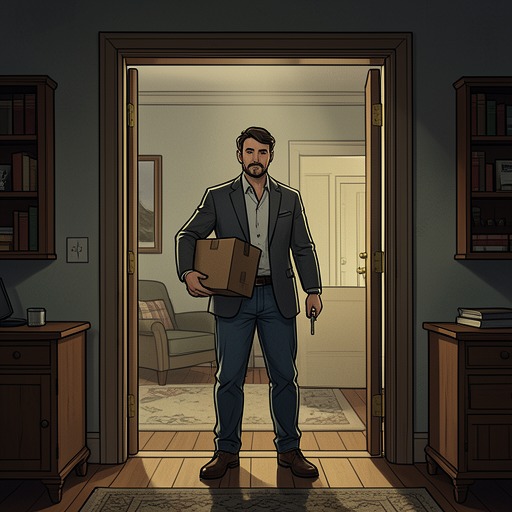
A discovers a box man living directly below his apartment window. He tries to ignore the intruder, then complains to the building janitor and the police, but nobody acts; the box man remains visible only to A and seems to expose how readily people collectively look away.
A week before A's transformation
A Fires at the Box
Borrowing an air rifle, A confronts the box man through the window. He shoots, uncertain where the bullet has struck, and watches the box leap before its occupant slowly rises and walks away without offering A the dramatic reaction he expected.
Immediately after A fires
The Box Man Leaves
A sees stains and discarded rubbish where the box man had been, and takes his departure as evidence that the shot found its mark. Yet the encounter leaves A unsettled: he changes his route to avoid the lane and keeps checking from his window for the person he claims to have driven away.
A few days after the shooting
A Tries the Carton
When a new refrigerator arrives in a suitably sized carton, A cannot bring himself to throw the box away. He crawls inside, later cuts an observation window in it, and begins testing the strange relief of viewing his familiar room from behind cardboard.
About a week after the shooting
A Becomes a Box Man
A starts spending most of his time in the box, then outfits it with supplies, paints his face in rainbow colors, and sleeps beneath it. He finally walks out into the street wearing it and does not return, having exchanged ordinary isolation for the anonymous freedom he had imagined.
For roughly three years before the final events
The Narrator's Box Life
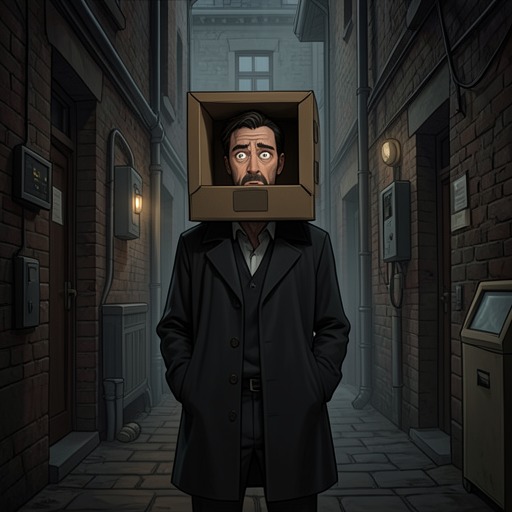
The narrator describes a life organized around the box: salvaging necessities, foraging for food, and moving through crowds as someone people rarely register. He insists that box men are not simply beggars or vagrants; the box is, for him, an entrance into another world rather than a dead end.
Before he became a box man
The Photographer's Past
Before taking up the box, the narrator worked as a photographer. That history leaves him with a camera and a practiced eye for images, but it also deepens his interest in observing people without being seen.
About a week before the bridge meeting
The Doctor's Shot
While relieving himself beside a soy-sauce factory, the narrator is struck in the shoulder by an air-rifle pellet. He sees a man carrying a rifle retreating up the road and, using his camera, takes photographs before the attacker disappears.
The day after the shooting
The Nurse's Help
A young woman on a bicycle stops long enough to tell the wounded narrator that a hospital lies up the slope, and leaves him money for treatment. Her brief kindness makes a powerful impression, especially her movement as she rides away.
Soon after the wound
The Attacker at the Hospital
At the hospital, the narrator recognizes the air-rifle attacker as the doctor and the bicycling stranger as a nurse. The apparent collision between the man who shot him and the woman who helped him feeds the narrator’s suspicion, though he cannot tell whether the two are acting together.
During the narrator's treatment
A Promise to Buy the Box
While recovering, the narrator becomes captivated by the nurse’s warmth and agrees to help her obtain a box from a box man. He makes an extravagant promise to buy it for her for 50,000 yen, even offering it free, without understanding what she intends to do with it.
The week after the hospital visit
The Narrator's Suspicion
The narrator grows convinced that the doctor and nurse may be conspiring against him. He imagines that the nurse will send the doctor as a substitute to kill him, and prepares to throw his written account into the canal if he is attacked.
A rainy night about a week after the shooting
The Bridge Meeting
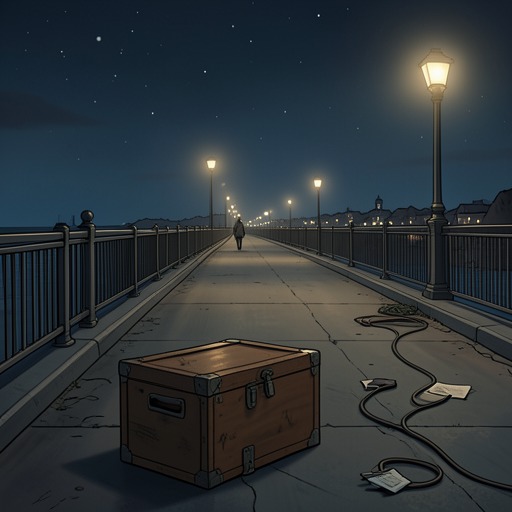
Under a bridge, the narrator waits for the nurse with his box and his notes, alternating between confidence and fear. He studies the canal’s whirlpools and plans how to preserve evidence should the meeting turn into an assault.
Later that rainy night
The Nurse's Letter
The nurse does not descend to the canal. Instead, she drops a bag containing a letter and five 10,000-yen bills, fulfilling the payment promised for the box and leaving its disposal to the narrator.
Immediately after the letter arrives
The Promise Kept
The narrator is thrown by the nurse’s straightforward fulfillment of her promise. He suspects that she may be trying to protect the doctor from acquiring the box, but resists throwing away a way of life he believes cannot be exchanged for a mere payment.
Later that night
A Visit by the Hospital
Still unwilling to accept the transaction as finished, the narrator goes to the hospital and uses a mirror to look through a high window. He sees the nurse naked in a room with another box man, whose carton appears to be an exact imitation of his own.
During the same night
The Box Man's Jealous Vigil
From outside, the narrator watches the nurse speak with the false box man and imagines the intimacy between them. His jealousy exposes the contradiction in his desire: he wants to look freely, yet resents being excluded from the scene and from the life he thinks the box might let him enter.
Before dawn
The Box Man Leaves the Window
The narrator retreats from the window without confronting the pair. He considers returning the money and giving up the box, but cannot yet decide whether he wants to leave the box or simply wants the nurse to help him do so.
During the final year of the war
The Doctor's Earlier Illness
C recounts that he served as an orderly to an [Army Medical Captain](entity:character-recall-character-941bca4aa7bd) who was researching how to extract sugar from wood. After an unexplained illness involving recurring fever, cramps, and neurological symptoms, the captain began suffering and asked C for drugs.
At the end of the war and after demobilization
C Begins the Unauthorized Practice
C continues caring for the ill captain after they leave the army and eventually helps establish a clinic. Because the captain is increasingly unable to examine or treat patients, C performs much of the medical work himself, without a license, while continuing to obtain drugs for his former superior.
During the clinic years
C and Nana
[Nana](entity:character-recall-character-nana-3fff93167fca), the captain’s legal wife, manages the clinic’s accounts, while C lives with her as her partner with the captain’s knowledge. C says that the captain’s fear of being abandoned helped drive him to pressure Nana to keep C close.
In the eighth year of the doctor's practice
The Clinic Moves
As the captain’s behavior becomes conspicuous and scrutiny of the clinic’s drug use grows, C and the captain close the practice and move to [T City](entity:location-recall-location-t-city-410a4a5dc908). The relocation begins a new arrangement in which C increasingly shields the captain from public view.
After the move to T City
C Takes the Doctor's Name
With the captain’s agreement, C begins presenting himself publicly under the captain’s name and credentials. He continues treating patients, believing his skill and their trust mitigate the deception, though he acknowledges that the practice remains illegal.
The year before the present-day events
Toyama Yoko Joins the Clinic
C hires [Toyama Yoko](entity:character-recall-character-toyama-yoko-1998f37b7bcf) as an apprentice nurse. [Nana](entity:character-recall-character-nana-3fff93167fca) objects and moves out, though she remains involved with the clinic’s accounts; Toyama Yoko’s arrival also intensifies the strained, intimate dynamics among the people surrounding the disguised practice.
In the months before the captain disappears
The Captain's Demands
The captain becomes increasingly withdrawn and suicidal, while his addiction and demands grow harder for C to manage. He insists on seeing [Toyama Yoko](entity:character-recall-character-toyama-yoko-1998f37b7bcf) naked and having her administer an enema, leaving C disturbed but reluctant to abandon the man he has cared for since the war.
During the narrator's life in the box
The Box Man's Recurrent Dream
The narrator imagines a fish dreaming that it is human: buoyant at first, then tormented by its lack of hands and legs and unsure whether it can wake. The fish is finally hurled from the sea and drowns in air, an image that mirrors the narrator’s uncertainty about whether escape from the box is possible.
Before the narrator became a box man
The Box Man and News
The narrator remembers a period of consuming newspapers, radio, and television news compulsively. Seeing a man die on a sidewalk makes him recognize that even the most dramatic reports reassure the living that the world has not ended for them.
During the narrator's reflections on box life
The Anonymous City
The narrator imagines a city where strangers need not defend themselves and people can sing, sleep by the roadside, or move among crowds without being judged. This ideal of anonymity explains why the box attracts him: it offers a way to disappear while remaining among other people.
During the narrator's reflections on box life
The Box as Legal Nonexistence
The narrator argues that box men exist outside the ordinary protections and recognition of society. He later pushes the idea further, claiming that those who live beyond the law can be treated as though their deaths do not count as crimes.
Across the narrator's three years in the box
The Box Man's Habits
The narrator describes learning how to forage, choose places to sleep, and keep only belongings that serve a practical purpose. He insists that the genuine box man grows accustomed to the town and its routines, while the imitation remains restless and bored.
The morning after the bridge meeting
The Old Box and B's Notebook
At [T City Seaside Bathing Beach](entity:location-recall-location-t-24e67ea4ecfd), the narrator recalls finding an abandoned, weathered box that appears to have belonged to another box man, whom he calls B. Inside it he found traces of a former life and a fragment of a notebook describing someone who had become unable to leave home and died unidentified.
That morning at T City Seaside Bathing Beach
The Narrator Delays Leaving
After washing himself and his clothes, the narrator considers discarding the box and visiting the hospital at eight. Yet he cannot fully let go, and his plans for confronting the nurse keep changing as he tries to turn uncertainty into a negotiation he can control.
The night before the last Monday in September
C Writes Before the Corpse
A later section addresses C as he drafts an affidavit about a death that has not yet occurred. He also begins notes predicting that an unidentified box man will be found drowned at [T Seaside Park](entity:location-recall-location-t-bba9c16f4565), while the account questions whether C is imagining, anticipating, or preparing the event.
The same night
C's Planned Cover Story
In the projected affidavit, C says that the body will be the [Army Medical Captain](entity:character-recall-character-941bca4aa7bd), who had disappeared from the clinic. He proposes that the captain may have wandered out in a box and accidentally fallen into the water, while acknowledging his long-running impersonation and illegal medical practice.
The night before the last Monday in September
The Doctor's Death Imagined
The narrator imagines C entering the [Morgue](entity:location-recall-location-5dd36eb8162b) to inject the captain with morphine and then stage his body as a drowning victim. The account is presented as an elaborate forecast rather than an independently confirmed event, leaving its reality entangled with the narrator’s notes and suspicions.
During the narrator's imagined account of the death
The Euthanasia Argument
The narrator cites the [Nagoya Superior Court](entity:organization-recall-organization-nagoya-superior-21a482d70553) precedent on euthanasia and argues that a box man’s life lies outside the law’s protection. His argument turns the imagined killing into a challenge to the moral assumptions by which society distinguishes mercy, murder, and the right to exist.
During D's childhood
D Builds a Periscope
D, a boy who longs to become strong, constructs a homemade periscope from plywood, cardboard, and mirrors. Looking through it changes his relation to the street: the world seems gentler when he can observe it while remaining hidden.
Later in D's childhood
D's Voyeuristic Plan
Encouraged by the periscope’s power to make the street feel welcoming, D turns his attention to the neighboring piano teacher. He plans to spy through a small opening near her toilet, mistaking his secrecy for a kind of timid, harmless confession of affection.
One afternoon around five
D Is Caught
D slips into the narrow space beside the teacher’s house and tries to position the periscope. Before he can see what he intended, the teacher detects him and orders him to come in rather than flee.
Immediately after D is caught
The Teacher's Punishment
The piano teacher confronts D about the embarrassment his spying has caused and makes him stand naked while she watches through a keyhole. Overwhelmed by shame, D loses control of his body; the humiliating punishment gives him a lasting understanding of what it means to be exposed to another person’s gaze.
At eight the morning after the bridge meeting
The Hospital Confrontation
The narrator returns to the hospital intending to settle matters with [Toyama Yoko](entity:character-recall-character-toyama-yoko-1998f37b7bcf) and the other box man. He finds the doctor inside a convincing replica of his box and learns that the man has spent the night in it, claiming to understand the attraction of box life.
During the hospital confrontation
The Replica's Proposal
The false box man proposes that the narrator stay with [Toyama Yoko](entity:character-recall-character-toyama-yoko-1998f37b7bcf) while he remains nearby, watching from his box. The narrator is tempted by the arrangement, but cannot accept being observed by someone whose gaze makes him feel exposed and displaced.
During the same confrontation
The Photograph Is Challenged
The narrator presents his photograph as proof that the doctor shot him, identifying the retreating figure by his shoes and clothing. [Toyama Yoko](entity:character-recall-character-toyama-yoko-1998f37b7bcf) and the false box man challenge his certainty, and the narrator’s evidence fails to settle the question of who is truly inside the box.
Moments later
The Air Rifle Appears
The false box man thrusts an air rifle through his observation window and demands to see the film. The narrator refuses, treating the photograph as his only safeguard against being silenced or stripped of his claim to the box.
Immediately after the gun is raised
The Crocodile Weapon
The narrator pulls out a stuffed crocodile filled with sand and swings it into the rifle barrel, knocking the shot away from his face. He then beats the person inside the box on the shin until the attack stops, taking control of the weapon and the encounter.
After the struggle
The Narrator Questions Reality
Even with the immediate danger apparently over, the narrator doubts that the events have happened as he describes them. He wonders whether the hospital, the people in it, and even his own account are inventions, and whether he may already have been poisoned or killed.
After the projected death at T Seaside Park
C's Deposition
A formal affidavit identifies C as the person who has been practicing under the [Army Medical Captain](entity:character-recall-character-941bca4aa7bd)’s name and explains his long history of caring for the captain. It offers a possible account of the captain’s disappearance and the boxed corpse, but the surrounding narrative has already made its reliability uncertain.
Later that morning
The Narrator Returns Naked
The narrator arrives at the hospital still inside his box and tells [Toyama Yoko](entity:character-recall-character-toyama-yoko-1998f37b7bcf) that he is the genuine box man, though he has no trousers and cannot leave the carton. He says he had meant to keep his promise, but his clothes disappeared while he slept at the seaside bathhouse.
Immediately after his return
The Nurse Accepts the Promise
[Toyama Yoko](entity:character-recall-character-toyama-yoko-1998f37b7bcf) laughs at the narrator’s predicament and says that a promise remains a promise. She begins undressing too, and tells him she cannot bear the box, allowing him to step out of it and approach her as himself.
That morning
The Box Man and Nurse Embrace
The narrator removes his box and embraces [Toyama Yoko](entity:character-recall-character-toyama-yoko-1998f37b7bcf), telling her he had been false even as he insists that the notes are the genuine box man’s testament. Their closeness briefly seems to offer the transformation he had hoped the box might make possible.
After the embrace
A Warning About the Notes
The account cautions that writing attributed to the dead need not tell the truth: a person facing death may leave behind lies shaped by jealousy or resentment. The warning unsettles the apparent confession and refuses to let the reader treat the notes as a reliable final record.
An undated dream near the end
The Wedding Dream
In a dream, the narrator is carried toward a wedding in a cart pulled by his father, who hides beneath a box rather than appear as a horse. The narrator’s attempt to urinate is seen by his bride, and the wedding is abandoned amid shame and confusion.
Within the same dream
The Stamp-Making Life
After the wedding fails, the narrator and his boxed father move to a city, where he draws tiny pictures of the lost woman. His sketches become popular and eventually turn into counterfeit stamps, an absurd success that cannot restore the relationship he has lost.
Near the end
Five Minutes of Lost Love
The narrator gives a one-man speech about a love that begins only after it has been lost. He insists that the immediate heat between people matters more than any conclusion, while his unseen listener urges him to keep the speech brief.
After the narrator's courtship fails
The Sealed Hospital
In another account, the narrator describes a period when he and [Toyama Yoko](entity:character-recall-character-toyama-yoko-1998f37b7bcf) live naked together inside the hospital, keeping their world within a narrow circle of touch and silence. When she eventually appears dressed and withdraws, he nails up the entrance and locks the emergency stairs, trapping the world inside with him.
After the hospital is sealed
The Nurse Disappears
The narrator cuts the power so that [Toyama Yoko](entity:character-recall-character-toyama-yoko-1998f37b7bcf)’s clothes will no longer separate them through the act of being seen. The room he enters has transformed into a station-side dead-end alley and an unfinished concrete ledge; she has vanished into the labyrinthine space he believes the box creates.
At the novel's end
The Ambulance Siren
The narrator declares that he has no regret and listens for the missing woman within the labyrinth of his account. An approaching ambulance siren sounds, but the narrative supplies no resolution about whether she will be found or what has happened to the narrator.